Three jobs share one name
Ask for "crown repair" and you may be quoted for a brushed-on coating, a patch or a full concrete casting. The three differ several times over in labor, and a quote that does not say which one it covers cannot be compared with another. Gaines Chimney Contractors casts and repairs crowns on brick chimneys across Garden Grove, and this is how we price each of the three and decide which one a chimney gets.
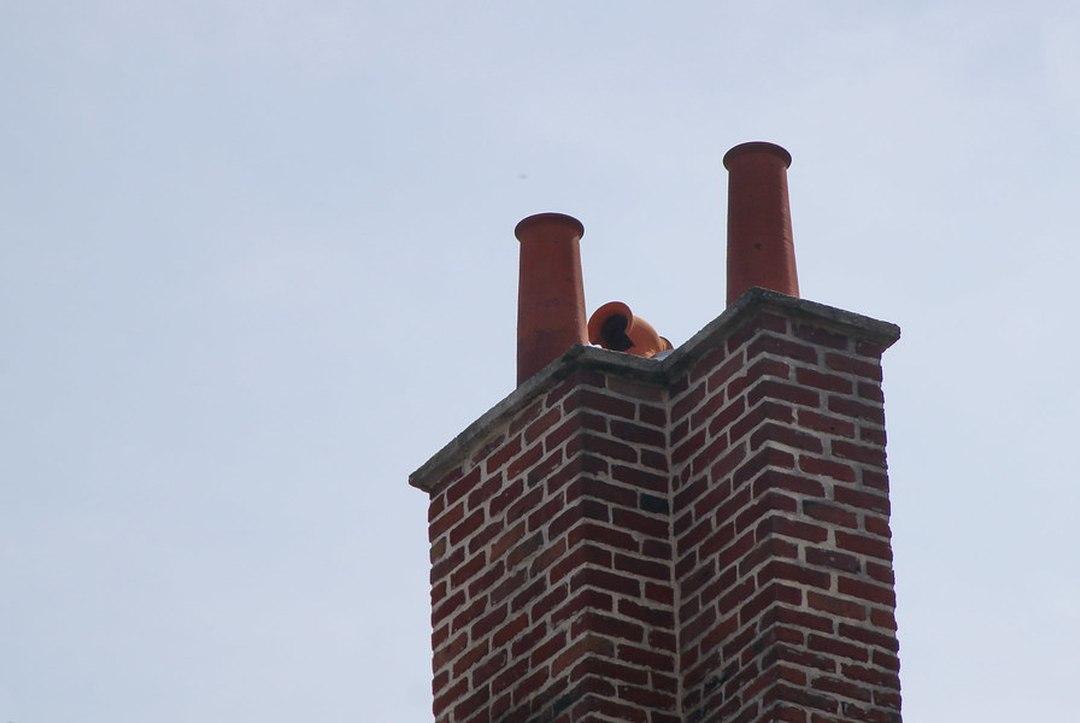
The crown is the slab that closes the top of the stack, spanning from the outer brick to the flue tile. Think of it as the lid on a hollow column. Everything below it, brick, mortar, liner, the framing in the attic, stays dry or gets wet according to how well that lid was made.
How the original was built matters most
On postwar tract houses the crown was often not a crown at all. The bricklayer finished the last course, troweled leftover mortar over the top, gave it a rough slope and moved to the next house. Mortar is made to sit between bricks, sheltered. Spread thin under sun and rain, it shrinks, crazes and finally breaks into plates.
A proper crown is a different material and a different shape: concrete with stone in it, a few inches thick, projecting past the brick on every side, with an isolating wrap around the flue tile so that tile and slab can move separately. If yours is the troweled-mortar kind, coatings and patches are buying time. If it is true concrete with a few cracks, repair is usually the right spend.
The three jobs
Coating. A flexible crown coating is brushed over the whole surface once it has been cleaned and its cracks packed. It suits a crown that is sound underneath: tight to the brick, no pieces loose, cracks no wider than the edge of a coin. It is the least labor of the three: hand tools, no formwork.
Patch and coat. Where a corner has broken away or one crack has opened through, the damaged section is cut back to firm material and rebuilt with a repair mortar, and then the entire crown is coated. This is sound work on a concrete crown with local damage. On a mortar wash it tends to chase the cracks around the slab from one winter to the next.
Recast. The old crown is broken out down to the top course. Loose top bricks are reset. A form is built around the stack, the flue tile is wrapped, and concrete is placed, sloped and finished with its projecting edge. If the top flue tile is cracked or stands too short, it is replaced while the top is open. This is a mason's job with a cure time, and it is priced accordingly.
What sets the figure for each
We do not print a crown price, because the spread between a small coating job and a large recast is too wide for one number to mean anything. These are the quantities the written quote is built from:
- Footprint. Length times width of the stack top. A single-flue stack is a small slab; a wide stack carrying a fireplace flue and a furnace flue can be three times the area.
- Number of flue tiles. Each one is wrapped, formed around and finished by hand.
- What lies under the old crown. If the top courses are loose, they are relaid first, and that is counted by the course.
- Top tile condition. A replacement tile and its setting are a line of their own.
- Height and roof. Concrete, forms and rubble all travel by ladder. Two stories, a steep pitch or a tile roof add staging.
- Cap. A crown with no cap leaves the flue open to the sky. If a cap is needed, it is quoted after we measure. A standard cap on one flue is the simplest job; a made-to-measure lid spanning several costs the most.
Signs that put a chimney in each group
From a ladder, or on the photos in an inspection report, the sorting goes like this.
- Fine surface crazing, slab tight, water sheds: coating.
- One open crack or a missing corner on real concrete: patch and coat.
- Slab rocking, plates lifting, weeds rooted in the cracks, mortar wash thinner than a finger: recast.
- White streaks or dark damp on the brick just under the crown, or top courses shedding mortar: recast, and repoint those courses in the same job.
- Rust stains running from the flue: the cap needs a look as well.
A Level 1 inspection at $160 sorts a crown into its group, with photos. If the top tile is cracked, we will suggest the $375 Level 2, so the camera can show how far down the damage runs before a new crown is cast around it.
What decides the next step
The material the crown is made of, and whether it is still attached. That is a quick judgment for a mason on the roof and close to impossible from the lawn.
Write down how many flues come through the top and whether the brick just below it is stained or shedding, and we will arrange a roof visit and return a written figure for the one job that fits.
Why crowns here wear the way they do
Garden Grove crowns take long dry summers followed by a handful of hard winter storms. A slab that has baked and shrunk for months is then asked to shed a great deal of rain in a short spell, and every hairline takes water in. Toward Huntington Beach, damp marine air keeps hairlines wet for longer and carries salt into them. None of this changes the three jobs. It does mean a coating on a mortar-wash crown is a short-term measure in this climate, and we say so on the quote when we find one.
Crown work alongside other repairs
A crown is seldom the only item. Because it sits on the top course, its timing is tied to everything else up there:
- Relining: the liner goes in before the crown is cast.
- Top-course rebuild: the crown is cast as the last act of that job.
- Repointing: the crown first, so new joints are not washed by a leaking top.
- Water repellent on the brick: after crown and joints, never as a substitute for them.
- Flashing: independent of the crown, though the same staging serves both.
Doing them in that order avoids paying for the same ladder work twice. Our masonry repair page and crown repair page describe how the jobs are combined on one quote, and chimney tuckpointing cost covers the joints beneath.
What a crown quote from us states
Vague crown quotes are the reason this post exists, so ours carries the following:
- Which of the three jobs it covers, by name
- The footprint in inches and the number of flue tiles
- For a recast: the material, the thickness at the thinnest point and how far the slab projects past the brick
- Whether the top tile is being kept or replaced
- Whether top courses are being relaid, and how many
- How the new concrete will be protected while it cures
- The cap, if one is part of the job, as its own priced line
A leak that has already reached a ceiling may have a second source lower down. If water is showing indoors, read chimney leak repair cost alongside this post.
Getting your crown priced
Whichever of the three your chimney needs, the quote will name it, give the footprint and state the material. To start, send a note through the contact page and our masons will go up and look.
Want This Checked on Your Own Chimney?
Gaines Chimney Contractors surveys and repairs chimneys from Garden Grove. Leave the address and a short note, and the scope comes back in writing once a mason has been up to the stack.